


How to use short passages to teach reading and improve students' vocabulary and comprehension?
All four skills are important in learning a foreign language. Reading can be very useful to help students improve their vocabulary, pronunciation, and comprehension in general. There are many advantages which are associated with reading, such as:
Reading strengthens our brain.
Increases the ability to empathize
Builds vocabulary
Gradually students become better readers.
Reading has a strong relationship with writing, which means that reading helps students to improve their writing. Students who read have better language proficiency.
Overall language competence is gained, benefiting all four skills, not just reading or writing in particular.
Reading develops a learner's autonomy. This can be motivated by extensive reading. Students should feel free to read what they want, at any time without being pressured.
Teachers are role models for students and they have the responsibility to introduce students to literary texts which are compatible with their age, preference, and language level. If a text is too difficult for a student to understand, then the student is discouraged to read.
In this short piece of reading by Hans Christian Andersen, students first will read the passage, and then with the help of a teacher, students write down the new words they don't know and find out their meanings by looking at a dictionary or using synonym to remember better and quicker.
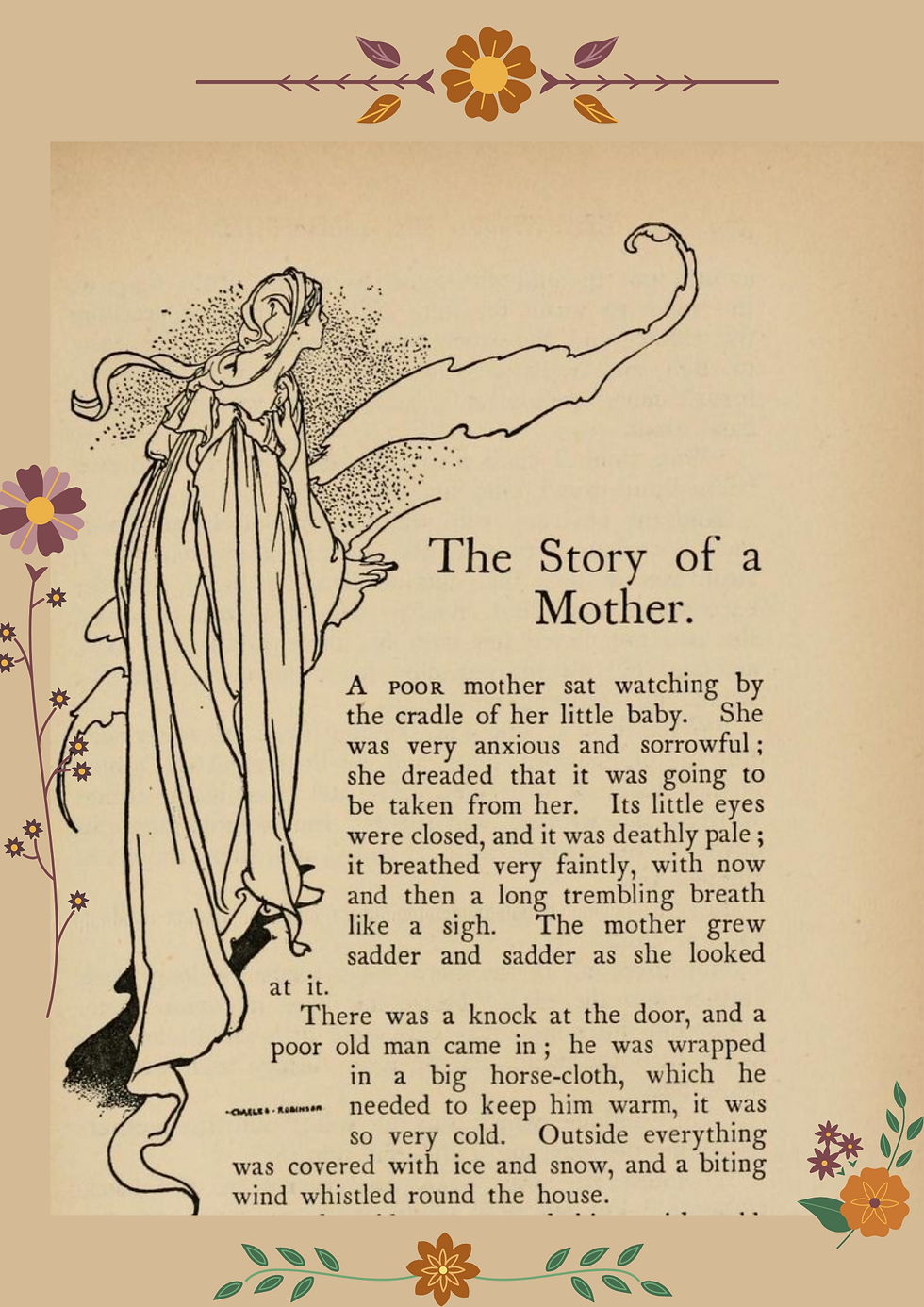
The teacher can already guess some of the words that the students might not know so she/he can prepare a list of them, illustrating with examples or giving synonyms to help students memorize quicker and in a logical way by making connections.
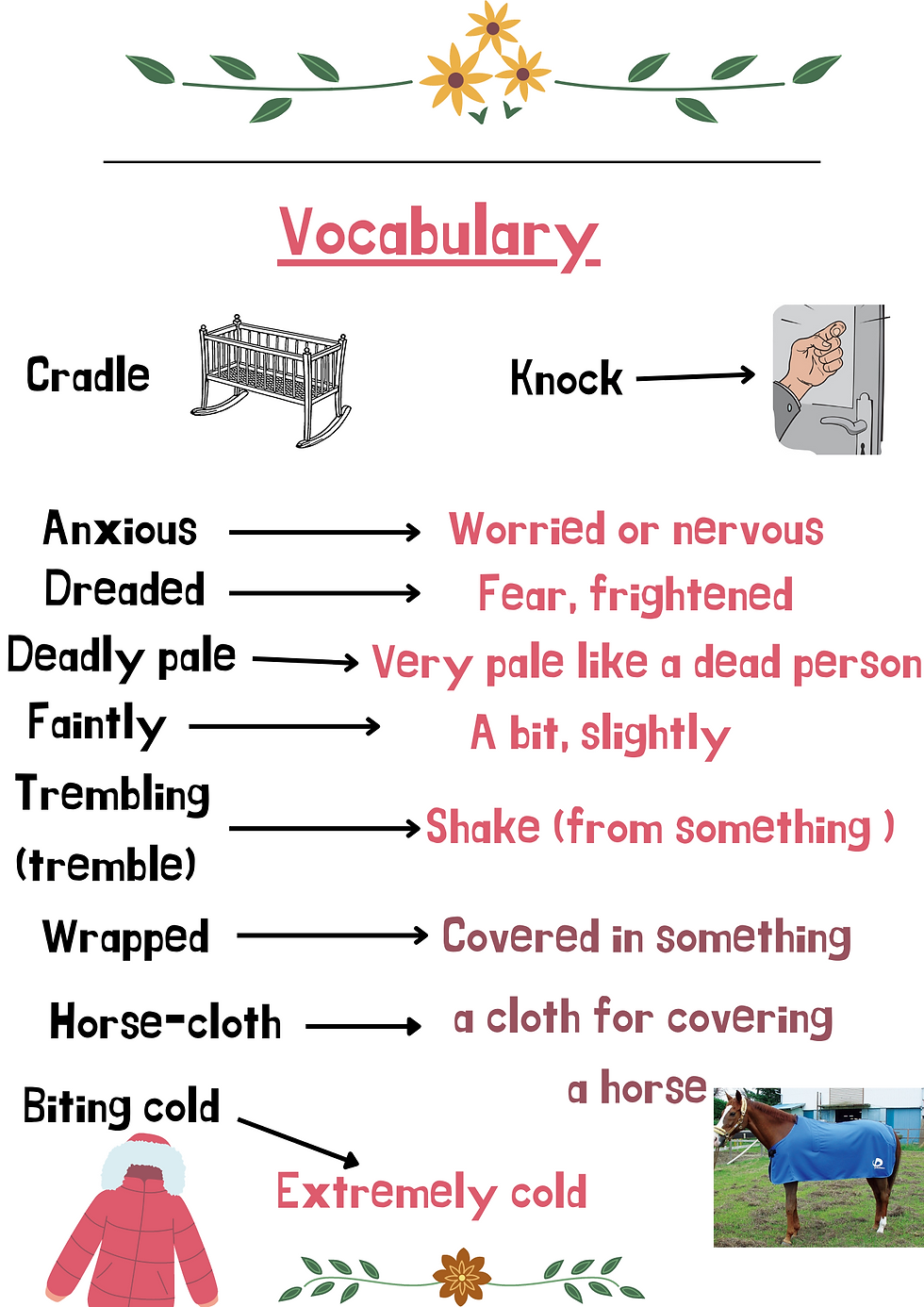
Let's take these words one by one.
Cradle - a type of bed used for babies to sleep in. Example: The mother was rocking the cradle until the baby fell asleep.
Knock - a type of sound like when you tap on somebody's house. Example: We were watching Tv when we heard a knock on the door.
Anxious - an adjective used to describe a feeling of being worried or nervous about something or someone. Example: Tomorrow I have an exam in mathematics. Math isn't my forte, and I can't stop feeling anxious.
Dreaded - comes from the verb dread, which describes a feeling of fear, being frightened of something. Example: I was hoping he would get better, but I dread he won't last for too long.
Deathly pale - when you refer to someone as deathly pale we mean that someone is very pale like a dead person. Example: After she watched the news, she was looking deathly pale, as if she might faint.
Faintly - is an adverb. Definition: slightly or not strongly. Example: She fell hard on the floor and everyone laughed. She seemed faintly embarrassedd as she continued to walk.
Tremble - means that a person is shaking because of something or someone, also it can refer to a part of the body, or the voice shaking involuntarily, typically as a result of anxiety or excitement. Example: Her hands were trembling in fear when she saw that someone had broken into her flat.
Wrap - to cover something or be covered in something like a cape or shawl, a loose garment. Example: He was very coldand wrappedd himself with a blanket. Or the mother wrappedd the baby with her cape.
Horse -cloth ( a type of garment used for covering horses, placedonn their backs.) Example: I can't find where I put my horse- cloth. Can I borrow your, pleasee?
Biting cold - a synonym for biting cold is 'extremely cold'. If we want to say that it is very cold like freezing outside, we can use biting cold as a perfect example.
Example: It was biting cold last night, maybe one of the coldest nights ever.
All these new words are just from a small passage. One piece of advice I always give my student despite their level, is to form sentences with every new word they encounter. It helps them to brainstorm about the word and at the same time learn how to use it in a sentence. Moreover, I noticed that they got more creative and confident when speaking. Lastly, they are introduced to brainstorming and not just passively writing down a new word and memorizing it by heart.


Comments